
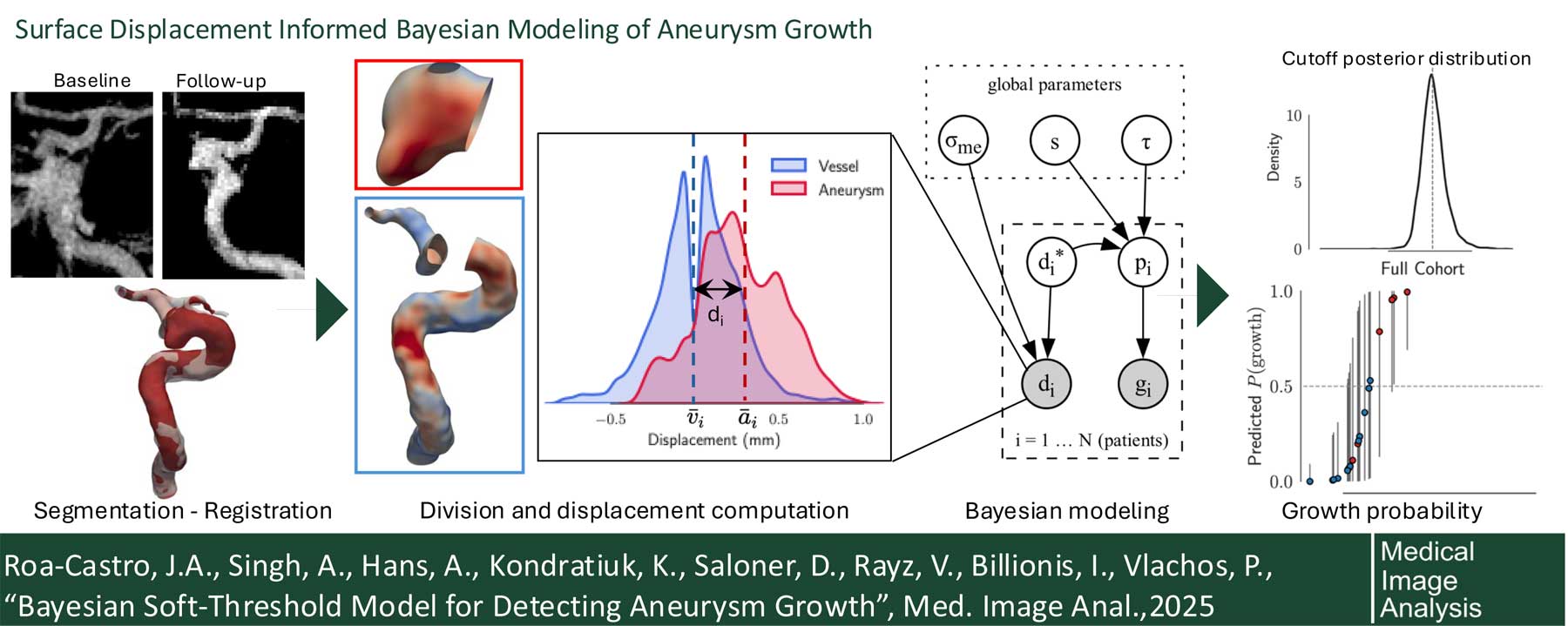
This project develops a probabilistic method to detect intracranial aneurysm growth from longitudinal MR angiography. Baseline and follow-up vascular surfaces are registered, partitioned into an aneurysm segment and a healthy-vessel segment, and compared through vertex-wise displacement distributions computed on baseline coordinates.
A patient-level mean-shift statistic compares aneurysm displacements against vessel displacements to control for segmentation, meshing, and registration effects. A Bayesian logistic soft-threshold model with measurement error maps the mean-shift to a posterior growth probability and provides uncertainty through credible intervals.