

Bayesian Soft-Threshold Model for Detecting Aneurysm Growth

Summary

Bayesian growth assessment from longitudinal MRA using displacement distributions with an internal vessel control.

Surface Displacement–Informed Bayesian Modeling for Aneurysm Growth Detection

Overview

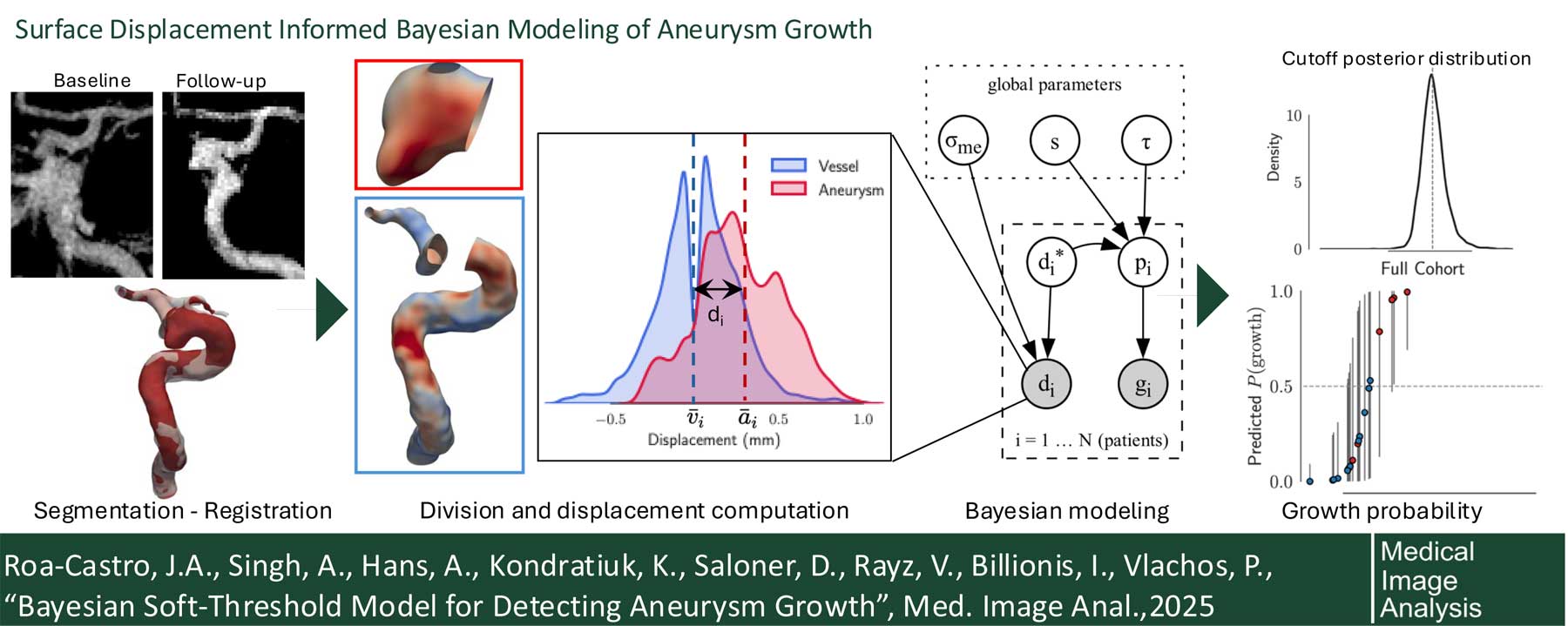
This project develops a probabilistic method to detect intracranial aneurysm growth from longitudinal MR angiography. Baseline and follow-up vascular surfaces are registered, partitioned into an aneurysm segment and a healthy-vessel segment, and compared through vertex-wise displacement distributions computed on baseline coordinates.

A patient-level mean-shift statistic compares aneurysm displacements against vessel displacements to control for segmentation, meshing, and registration effects. A Bayesian logistic soft-threshold model with measurement error maps the mean-shift to a posterior growth probability and provides uncertainty through credible intervals.


Publications

Manuscript in preparation — link forthcoming

Collaborators

External Collaborators:
  • Jorge A. Roa-Castro
  • Kostiantyn Kondratiuk
  • David Saloner
  • Vitaliy L. Rayz

PSL Partners

perdue
UCSF

Scientific Machine Learning & AI for Engineering

Join Prof. Bilionis’ Substack community for deep dives into uncertainty quantification, AI-driven simulations, and the latest laboratory updates.

Ilias Bilionis